
Wireless Park ‘n Charge (Wireless PnC) is a Canadian cleantech company on a mission to reduce the automotive sector’s carbon footprint. Their cutting-edge wireless electric vehicle (EV) charging solutions aim to catalyze the widespread adoption of sustainable transportation options. With leverage funding from the Southern Ontario Network of Advanced Manufacturing Industry (SONAMI), Wireless PnC partnered with Centennial Innovates — the applied research, innovation and entrepreneurship department at Centennial College — on a collaborative applied research project that advanced the company’s development of a universal charging solution for light to medium-sized electric vehicles.
Launched in March 2025, the project focused on designing a state-of-the-art wireless charging and docking station that enhances the EV user experience. The system integrates precise alignment mechanisms, locking systems, advanced sensors, and durable materials — all while considering future scalability for large-scale manufacturing.
By addressing existing technical and infrastructure gaps in light electric vehicles (LEVs), the project aligns with Canada’s federal clean growth priorities by promoting zero-emission transportation and supporting the 2030 emissions reduction target. The charging station expands the availability of smart mobility solutions in Canada, reducing reliance on fossil fuels and lowering transportation-related greenhouse gas emissions across the country.

(Photo credit: ruudi productions)
“Working with SONAMI has helped us move quickly from design into manufacturing, which is critical for a young company recovering from the delays and risks that come with developing new technology,” said Samira Soltani, Co-Founder and CEO of Wireless PNC. “The project has already accelerated our progress and given us confidence in scaling a platform that makes clean mobility more practical and accessible. This support strengthens our ability to grow in a sustainable way while contributing to lower-emission transport solutions in Canadian cities.”
She also emphasized the crucial support received from SONAMI: “It allowed us to move directly from design to fabrication, cutting months off our development timeline,” she remarked. “This immediate acceleration means we can begin testing our wireless charging platform in real-world settings much sooner, bringing us closer to commercialization and market entry.”
“This project gave me real experience in teamwork, problem-solving, and applying what I learned in class to real situations.”
– Laya Abdoliafaghan, Mechanical Engineering student
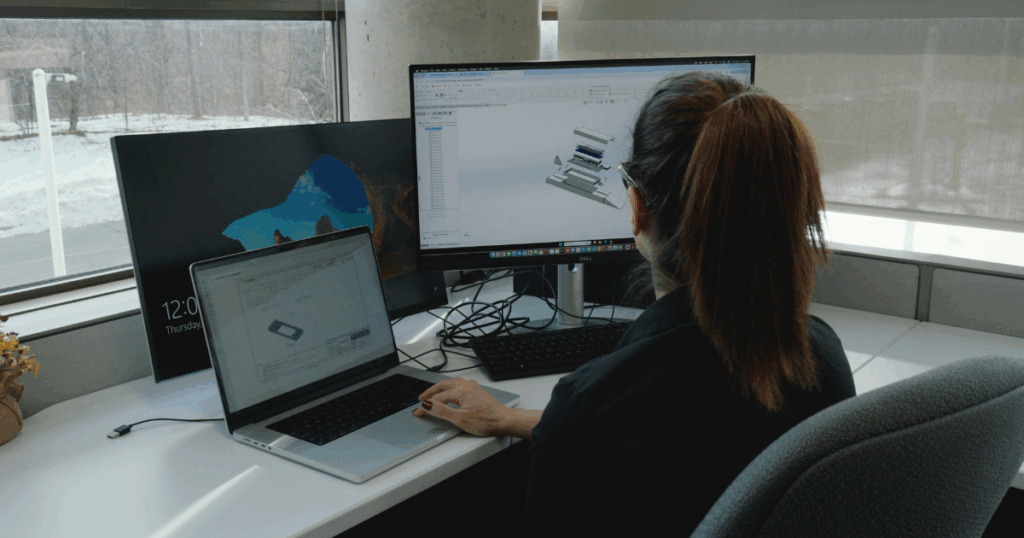
The project’s mechanical design and prototyping were developed by student researchers Laya Abdoliafaghan and Kyth Cuaton from the Advanced Diploma in Mechanical Engineering program, under the guidance of Centennial faculty researcher Wladimir Figueiredo. On the electrical side, Professor Kamran Farhani supervised student researchers Dalylal Horn and Yuxin Gao from the Electrical Engineering Technology program.
Working as a student researcher can really enhance future job opportunities. “Don’t be afraid to try something new, even if you don’t have much experience,” said Laya, who has a Bachelor’s degree in Metallurgical and Materials Engineering. “Working on research projects is a great way to build skills, meet new people, and prepare for your future career.
“This project gave me real experience in teamwork, problem-solving, and applying what I learned in class to real situations,” she added. “I also worked with industry partners, which helped me understand how research connects to real-world needs. I learned new skills like 3D modelling, testing prototypes, and communicating technical ideas clearly. I’m especially proud of improving my design and project coordination skills.”
The research team achieved a major milestone through this collaboration: the successful start of manufacturing for the platform, with components now moving into production. Reaching this stage demonstrates the effectiveness of SONAMI’s technical expertise in bridging the gap between early-stage design and tangible, manufacturable hardware.
By engaging directly with municipal and fleet partners, the team was also able to validate the product’s market needs and refine the product roadmap—ensuring the solution is grounded in real-world priorities such as cost savings and durability. Overall, the project has improved Wireless PNC’s technical capacity, reduced development risks, and accelerated the team’s momentum and clarity in scaling the technology. Externally, the company is seeing growing interest from municipalities and fleets that recognize the platform’s potential.
Looking ahead, this collaboration lays the groundwork for new high-skilled employment in clean technology and strengthens Canada’s advanced manufacturing ecosystem. It also encourages the broader adoption of micromobility by providing reliable charging infrastructure that directly supports the transition toward lower-emission cities.
About FedDev Ontario
For over 15 years, the Government of Canada, through FedDev Ontario, has worked to advance and diversify the southern Ontario economy through funding opportunities and business services that support innovation, growth and job creation in Canada’s most populous region. The Agency has delivered impressive results, which can be seen in southern Ontario businesses that are creating innovative technologies, improving productivity, growing revenues, creating jobs, and in the economic advancement of communities across the region. Learn more about the impact the Agency is having in southern Ontario by exploring our investment profiles, our Southern Ontario Spotlight, and FedDev Ontario’s X, Facebook, Instagram and LinkedIn accounts.